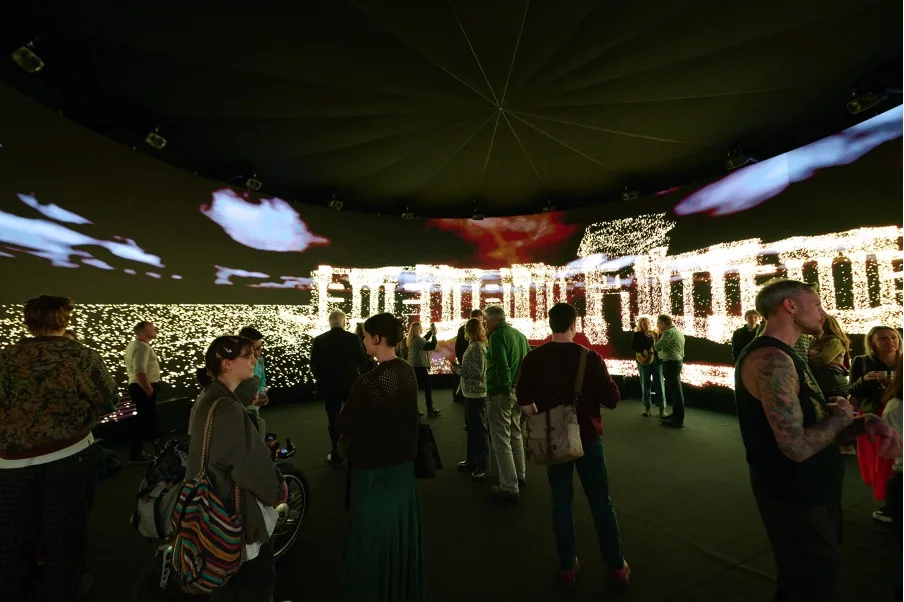
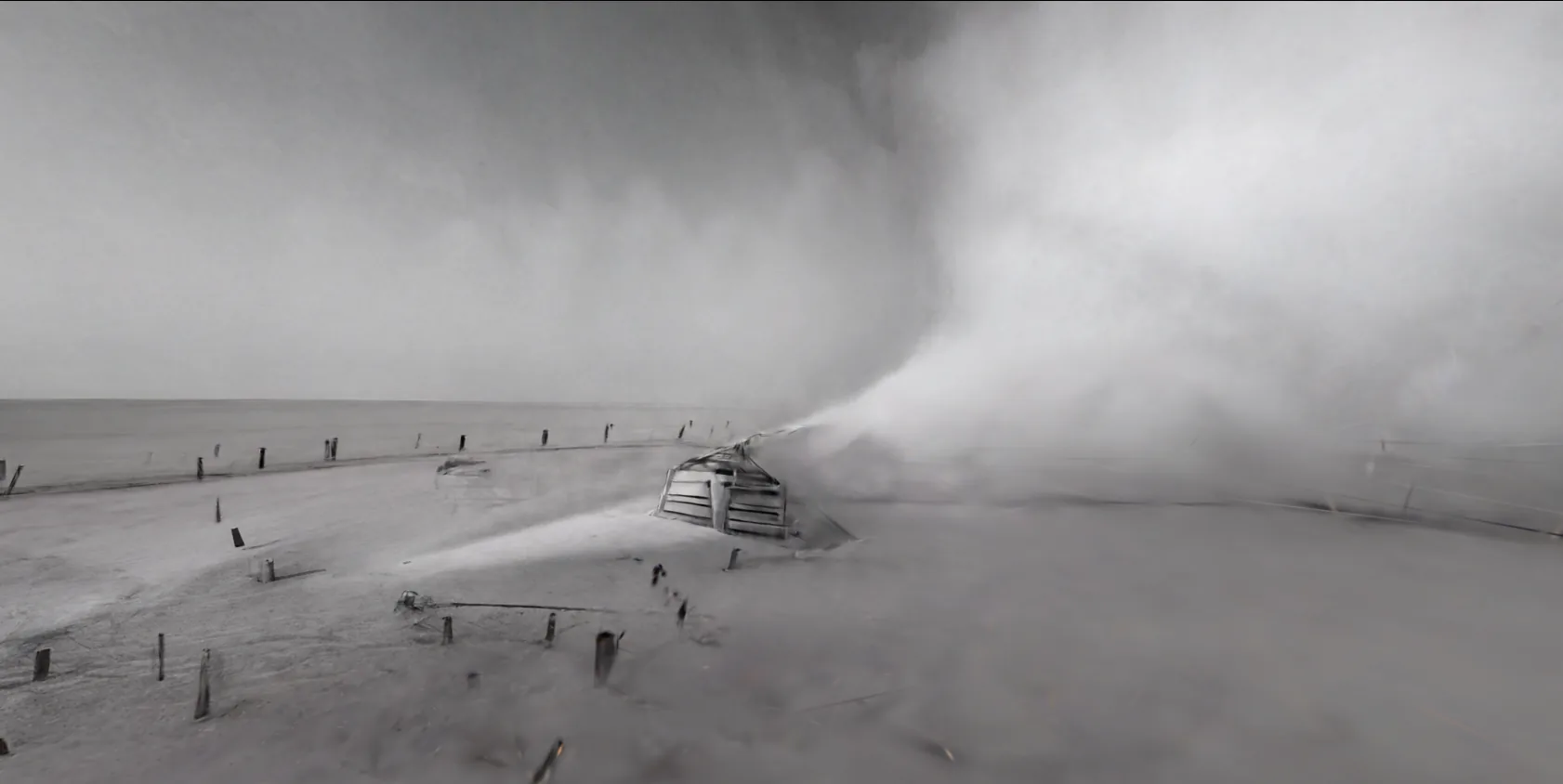
HarmonicAI Brokedown is an immersive installation and robotic performance that connects two landscapes shaped by environmental collapse, human ambition, and collective forgetting: the American Dust Bowl of the 1930s and the Norfolk Brecks village of Santon Downham, which was overwhelmed by drifting sands following agricultural mismanagement and speculative land use in the seventeenth century. Although separated by centuries and continents, both places reveal a recurring pattern in human history. When ecological limits are ignored in pursuit of economic growth, the land eventually responds, often with consequences that persist for generations.
At the heart of the project is Harmonica Breakdown (1938), the iconic solo dance choreographed by Jane Dudley, one of the most significant figures in American modern dance. After performing with the Martha Graham Company, Dudley became renowned for creating choreography that fused movement and social commentary, later becoming Director of Contemporary Dance at the London Contemporary Dance School. Accompanied by a blues harmonica score by Sonny Terry, Harmonica Breakdown explores the human consequences of environmental catastrophe. Dudley described the work as “a dance of misery and defiance rising out of it”, capturing the tension between suffering and resistance that emerged during the Dust Bowl years.
The project uses advanced motion-capture systems, movement analysis, robotics, and generative AI to record, interpret, and creatively transform Dudley’s choreography. Drawing on archival film documentation and contemporary performance practice, the dance is translated into digital movement data, enabling new forms of embodiment across virtual characters, machine-learning systems, and robotic performers. Rather than preserving a fixed historical artefact, HarmonicAI Brokedown treats choreography as a living archive, continuously reinterpreted through contemporary technologies.
Visitors encounter immersive virtual environments reconstructed from photographs produced by the Farm Security Administration photography programme, directed by Roy E. Stryker between 1935 and 1944. Photographers including Dorothea Lange, Walker Evans, and Arthur Rothstein documented the human and environmental impacts of the Dust Bowl, producing one of the most important visual records of ecological crisis in modern history. These images are transformed through machine learning, photogrammetric reconstruction, and spatial computing into navigable digital landscapes populated by traces of movement, memory, and loss.
The installation is motivated by a pressing contemporary concern: our collective failure to remember environmental lessons from the past. The Dust Bowl emerged not simply from drought but from a combination of climatic extremes, intensive cultivation, speculative agricultural expansion, and the destruction of resilient prairie ecosystems. Hundreds of thousands of people were displaced as fertile land became dust. Similar dynamics can be identified today in regions facing increasing climate stress, resource extraction, and rapid technological development. Across North America, dust storms are again becoming more frequent, while large-scale digital infrastructure projects increasingly occupy areas vulnerable to water scarcity and extreme heat.
By linking the Dust Bowl to the buried landscape of Santon Downham, HarmonicAI Brokedown reveals how environmental crises recur when societies disconnect economic ambition from ecological understanding. Through dance, robotics, artificial intelligence, archival imagery, and immersive media, the project explores how memory can be encoded within bodies, landscapes, and machines. It asks whether emerging technologies can help us remember what history repeatedly teaches: that the consequences of environmental mismanagement are never confined to the past, but continue to shape the futures we are creating today.